 University of Illinois Urbana-Champaign
Siebel School of Computing and Data Science
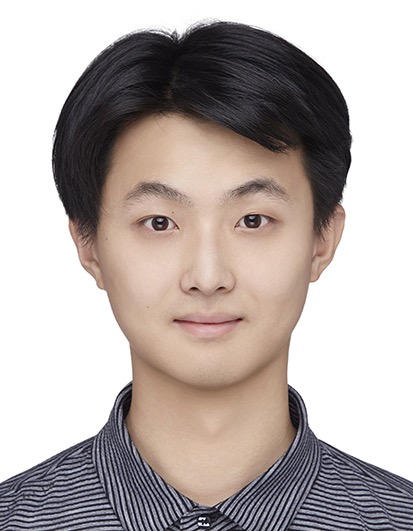
Hi! I am Ruihan Guo, a first-year CS Ph.D. student at the University of Illinois Urbana-Champaign, advised by Prof. Ge Liu.
My research interests lie in generative modeling and controllable generation, with a focus on their applications to molecular design. I am also broadly interested in AI-driven drug discovery and biomolecular design, including antibody design and protein engineering.
Before joining UIUC, I spent three years at Helixon, an AI-biotech startup, where I worked with Jianzhu Ma and Jian Peng.
Warning
Problem: The current name of your GitHub Pages repository ("Solution: Please consider renaming the repository to "
http://".
However, if the current repository name is intended, you can ignore this message by removing "{% include widgets/debug_repo_name.html %}" in index.html.
Action required
Problem: The current root path of this site is "baseurl ("_config.yml.
Solution: Please set the
baseurl in _config.yml to "Education
-
University of Illinois Urbana-ChampaignPh.D. in Computer Science, Siebel School of Computing and Data ScienceAug. 2025 - Present
-
 Shanghai Jiao Tong UniversityB.E. in Computer ScienceSept. 2018 - Jul. 2022
Experience
-
Shanghai Jiao Tong UniversityAEPX lab, Research InternJul. 2020 - Apr. 2021
-
University of Illinois Urbana-ChampaignResearch InternSept. 2021 - Aug. 2022
-
 Helixon Inc.Research ScientistSept. 2022 - Present
Honors & Awards
-
Gold Medal, ACM-ICPC Asia-East Continent FinalNov. 2018
-
Champion, ACM-ICPC Asia Regional Contest, Hong Kong SiteNov. 2018
-
Gold Medal, ACM-ICPC Asia Regional Contest, Nanjing SiteOct. 2018
-
Gold Medal, China Collegiate Programming Contest, Qinhuangdao SiteSept. 2018
Selected Publications (view all )
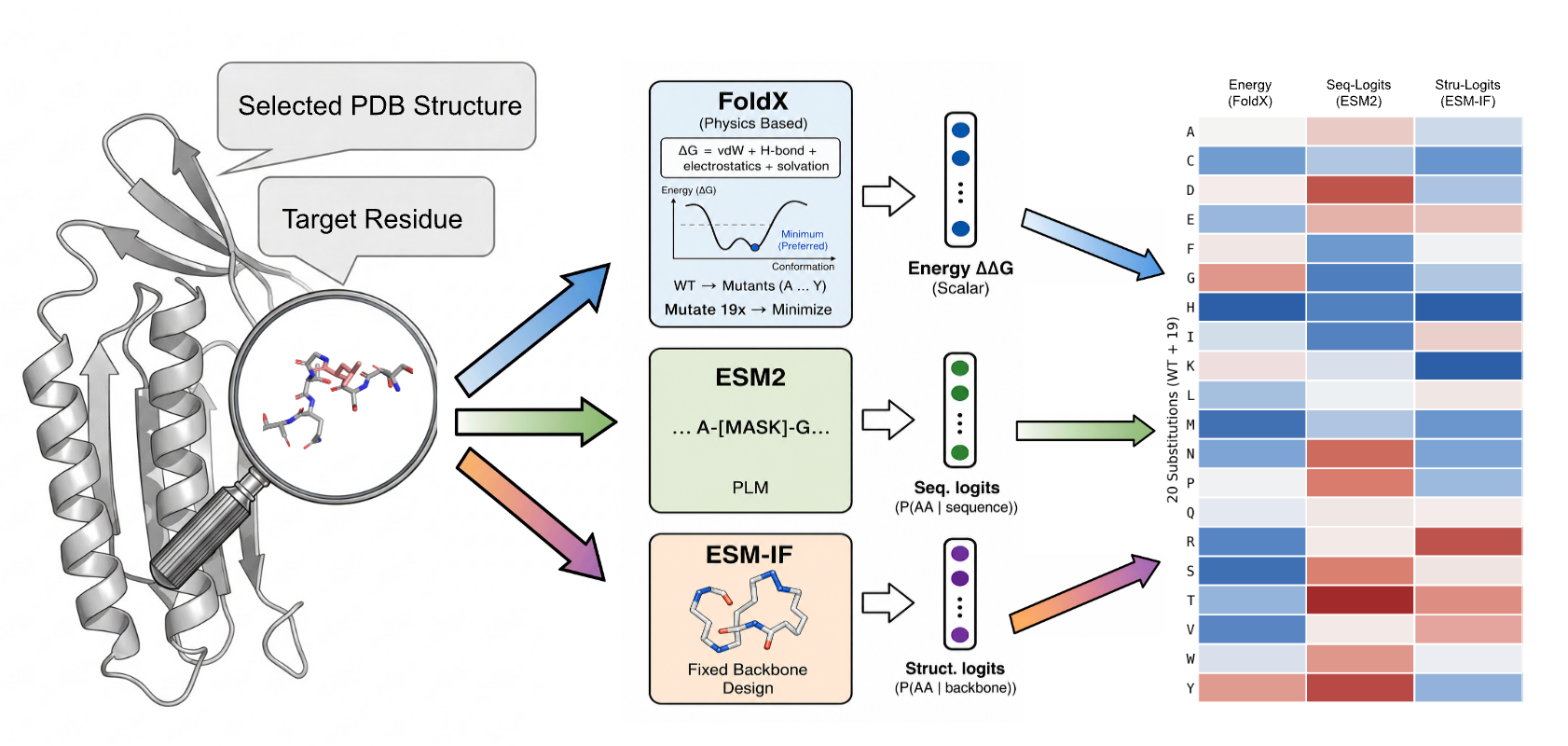
MutAtlas: A PDB-Wide Energy-Guided Atlas of Protein Mutation Effects
Ruihan Guo, Chaoran Cheng, Zhanghan Ni, Neil He, Bangji Yang, Ge Liu
International Conference on Machine Learning (ICML) 2026
We construct a PDB-wide, structure-aligned mutation augmentation dataset that aligns signals from physics-based energy models, protein language models, and inverse folding models, and propose an unsupervised multi-source mutation preference distillation framework that explicitly models cross-source disagreement. Without using any experimental mutation labels during training, our approach achieves consistent improvements on the ProteinGym benchmark over zero-shot baselines and naive multi-source fusion strategies.
MutAtlas: A PDB-Wide Energy-Guided Atlas of Protein Mutation Effects
Ruihan Guo, Chaoran Cheng, Zhanghan Ni, Neil He, Bangji Yang, Ge Liu
International Conference on Machine Learning (ICML) 2026
We construct a PDB-wide, structure-aligned mutation augmentation dataset that aligns signals from physics-based energy models, protein language models, and inverse folding models, and propose an unsupervised multi-source mutation preference distillation framework that explicitly models cross-source disagreement. Without using any experimental mutation labels during training, our approach achieves consistent improvements on the ProteinGym benchmark over zero-shot baselines and naive multi-source fusion strategies.
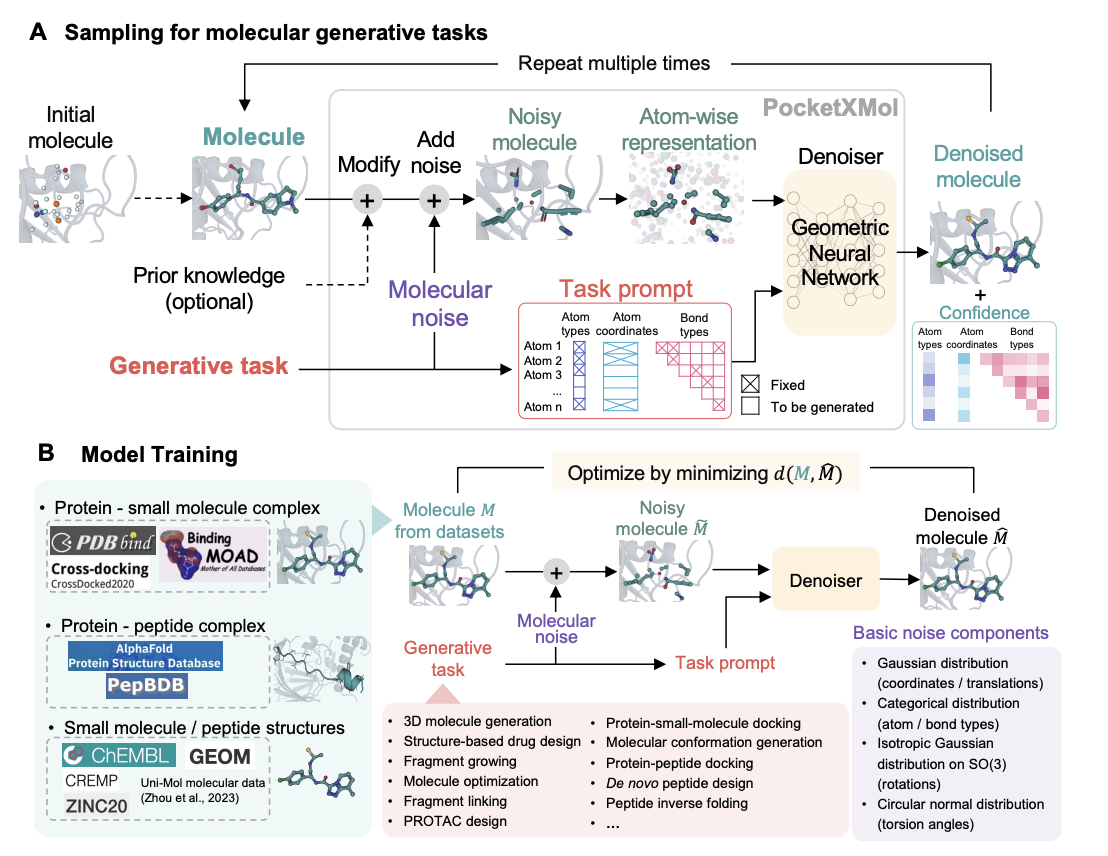
Decipher Fundamental Atomic Interactions to Unify Generative Molecular Docking and Design
Xingang Peng, Ruihan Guo, Yan Xu, Jiaqi Guan, Yinjun Jia, Yanwen Huang, Muhan Zhang, Jian Peng, Jiayu Sun, Chuanhui Han, Zihua Wang, Jianzhu Ma
Cell 2026
PocketXMol is an all-atom model that unifies diverse molecular tasks under a single framework without fine-tuning, excelling in small molecule and peptide design, with demonstrated success in creating caspase-9 inhibitors and PD-L1-binding peptides validated in cellular and animal models.
Decipher Fundamental Atomic Interactions to Unify Generative Molecular Docking and Design
Xingang Peng, Ruihan Guo, Yan Xu, Jiaqi Guan, Yinjun Jia, Yanwen Huang, Muhan Zhang, Jian Peng, Jiayu Sun, Chuanhui Han, Zihua Wang, Jianzhu Ma
Cell 2026
PocketXMol is an all-atom model that unifies diverse molecular tasks under a single framework without fine-tuning, excelling in small molecule and peptide design, with demonstrated success in creating caspase-9 inhibitors and PD-L1-binding peptides validated in cellular and animal models.
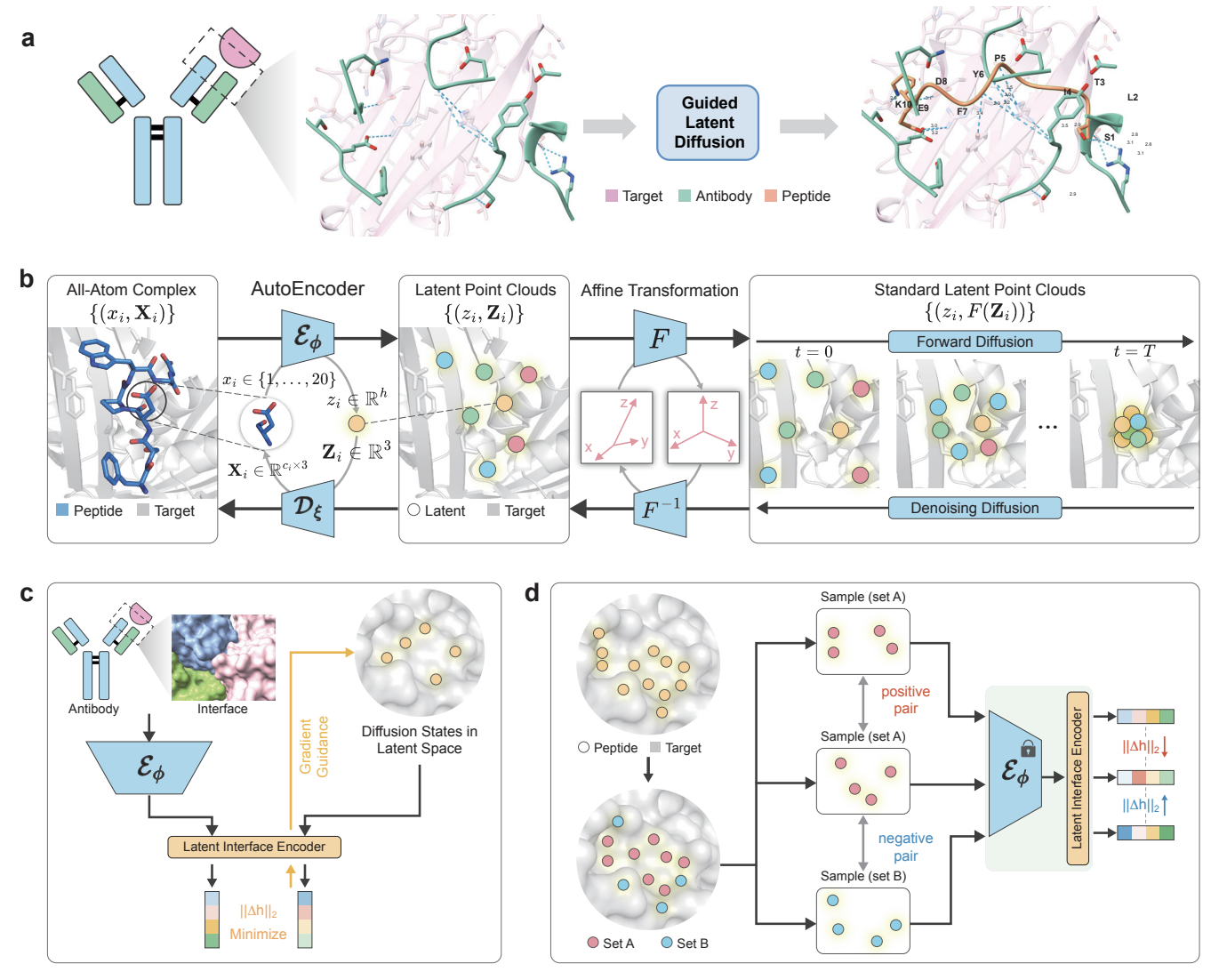
Peptide design through binding interface mimicry with PepMimic
Xiangzhe Kong, Rui Jiao, Haowei Lin, Ruihan Guo, Wenbing Huang, Wei-Ying Ma, Zihua Wang, Yang Liu, Jianzhu Ma
Nature Biomedical Engineering 2025
PepMimic is an machine learning model for designing peptide drug candidates by mimicking binding interfaces, achieving dissociation constants as low as $10^{-9}$M with a success rate 20,000 times higher than random screening, and demonstrating therapeutic potential through extensive cellular and in vivo validations.
Peptide design through binding interface mimicry with PepMimic
Xiangzhe Kong, Rui Jiao, Haowei Lin, Ruihan Guo, Wenbing Huang, Wei-Ying Ma, Zihua Wang, Yang Liu, Jianzhu Ma
Nature Biomedical Engineering 2025
PepMimic is an machine learning model for designing peptide drug candidates by mimicking binding interfaces, achieving dissociation constants as low as $10^{-9}$M with a success rate 20,000 times higher than random screening, and demonstrating therapeutic potential through extensive cellular and in vivo validations.
Enhancing Protein Mutation Effect Prediction through a Retrieval-Augmented Framework
Ruihan Guo*, Rui Wang*, Ruidong Wu*, Zhizhou Ren, Jiahan Li, Shitong Luo, Zuofan Wu, Qiang Liu, Jian Peng, Jianzhu Ma (* equal contribution)
NeurIPS 2024
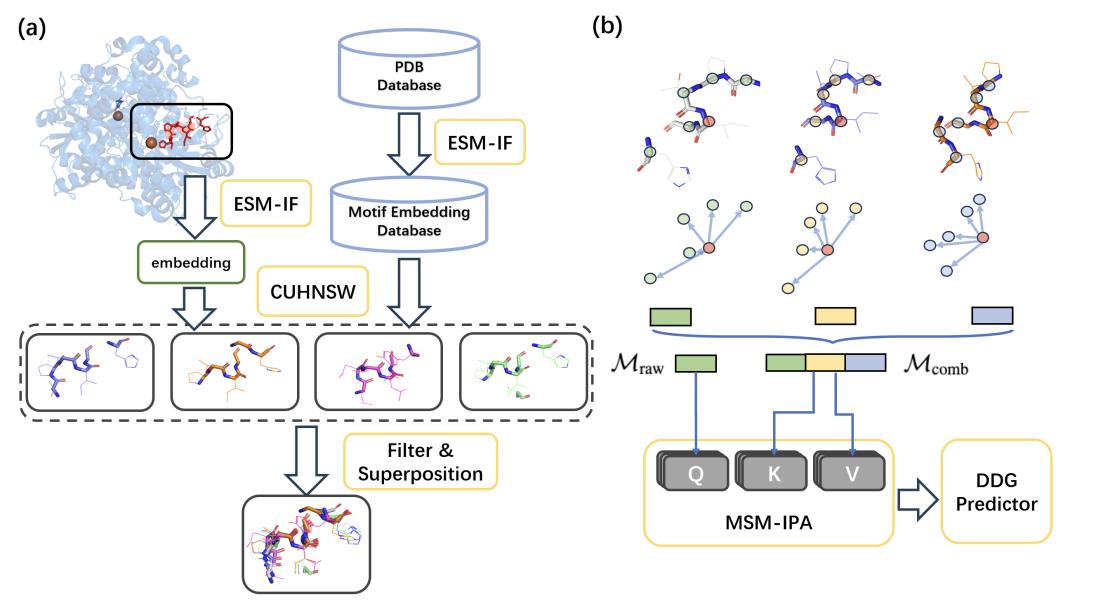
This work introduces a retrieval-augmented framework that incorporates similar local structural motifs from a pre-trained protein structure encoder, achieving state-of-the-art performance in protein mutation effect prediction and providing a scalable solution for studying mutation impacts.
Enhancing Protein Mutation Effect Prediction through a Retrieval-Augmented Framework
Ruihan Guo*, Rui Wang*, Ruidong Wu*, Zhizhou Ren, Jiahan Li, Shitong Luo, Zuofan Wu, Qiang Liu, Jian Peng, Jianzhu Ma (* equal contribution)
NeurIPS 2024
This work introduces a retrieval-augmented framework that incorporates similar local structural motifs from a pre-trained protein structure encoder, achieving state-of-the-art performance in protein mutation effect prediction and providing a scalable solution for studying mutation impacts.
Full-Atom Peptide Design based on Multi-modal Flow Matching
Jiahan Li*, Chaoran Cheng*, Zuofan Wu, Ruihan Guo, Shitong Luo, Zhizhou Ren, Jian Peng, Jianzhu Ma (* equal contribution)
ICML 2024
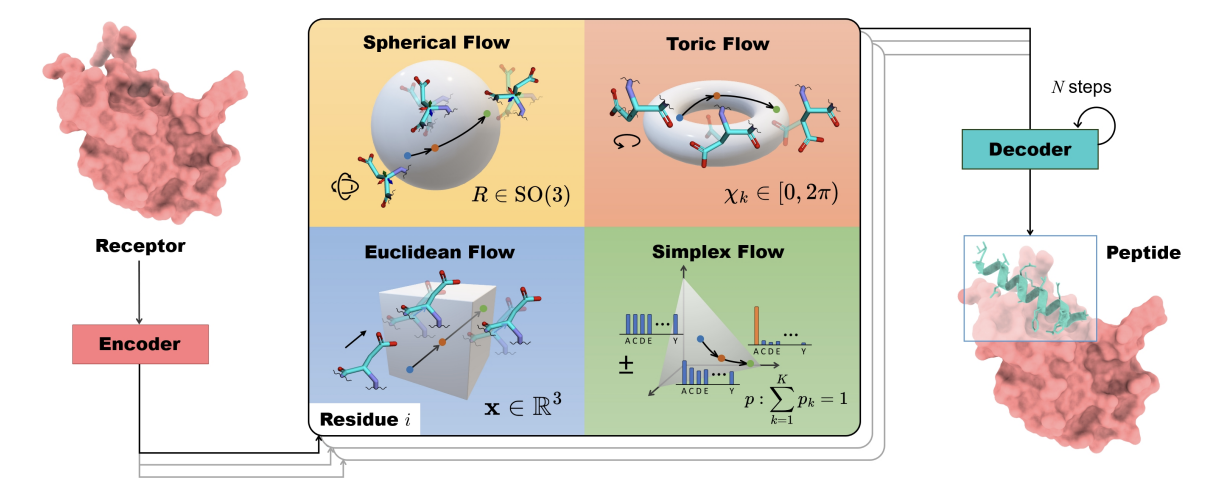
PepFlow introduces a multimodal deep generative model based on the flow-matching framework for full-atom peptide design, leveraging SE(3) manifolds and high-dimensional tori to model backbone orientations and side-chain dynamics, achieving state-of-the-art performance across peptide design tasks.
Full-Atom Peptide Design based on Multi-modal Flow Matching
Jiahan Li*, Chaoran Cheng*, Zuofan Wu, Ruihan Guo, Shitong Luo, Zhizhou Ren, Jian Peng, Jianzhu Ma (* equal contribution)
ICML 2024
PepFlow introduces a multimodal deep generative model based on the flow-matching framework for full-atom peptide design, leveraging SE(3) manifolds and high-dimensional tori to model backbone orientations and side-chain dynamics, achieving state-of-the-art performance across peptide design tasks.
FAFE: Immune Complex Modeling with Geodesic Distance Loss on Noisy Group Frames
Ruidong Wu*, Ruihan Guo*, Rui Wang*, Shitong Luo, Yue Xu, Jiahan Li, Jianzhu Ma, Qiang Liu, Yunan Luo, Jian Peng (* equal contribution)
ICML 2024 Spotlight
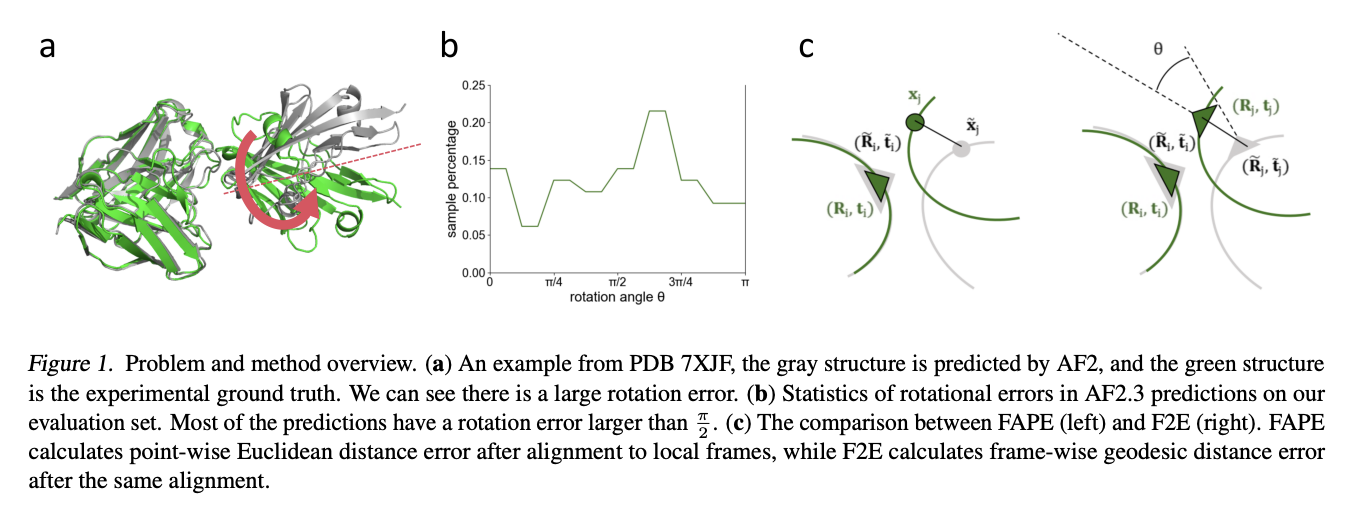
This work introduces Frame Aligned Frame Error (FAFE), a novel geodesic loss that overcomes AlphaFold2's gradient vanishing issue in high-rotational-error targets, enabling more accurate antibody-antigen complex modeling and achieving up to a 182% improvement in correct docking rates.
FAFE: Immune Complex Modeling with Geodesic Distance Loss on Noisy Group Frames
Ruidong Wu*, Ruihan Guo*, Rui Wang*, Shitong Luo, Yue Xu, Jiahan Li, Jianzhu Ma, Qiang Liu, Yunan Luo, Jian Peng (* equal contribution)
ICML 2024 Spotlight
This work introduces Frame Aligned Frame Error (FAFE), a novel geodesic loss that overcomes AlphaFold2's gradient vanishing issue in high-rotational-error targets, enabling more accurate antibody-antigen complex modeling and achieving up to a 182% improvement in correct docking rates.
Learning Long-Term Reward Redistribution via Randomized Return Decomposition
Zhizhou Ren, Ruihan Guo, Yuan Zhou, Jian Peng
ICLR 2022 Spotlight
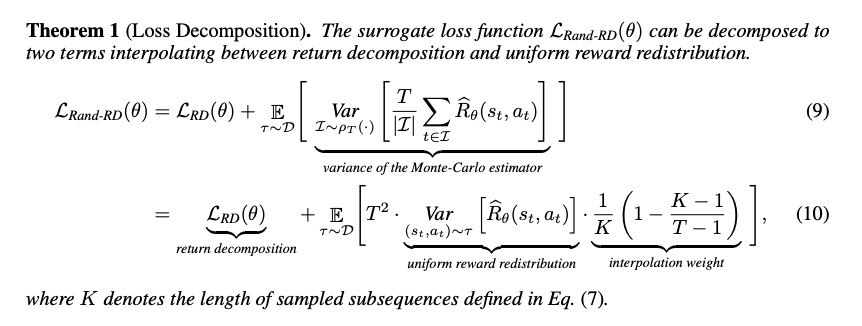
This work addresses episodic reinforcement learning with trajectory feedback by introducing Randomized Return Decomposition (RRD), a reward redistribution algorithm that uses Monte-Carlo sampling to scale least-squares-based proxy reward learning for long-horizon tasks, achieving significant improvements over baseline methods.
Learning Long-Term Reward Redistribution via Randomized Return Decomposition
Zhizhou Ren, Ruihan Guo, Yuan Zhou, Jian Peng
ICLR 2022 Spotlight
This work addresses episodic reinforcement learning with trajectory feedback by introducing Randomized Return Decomposition (RRD), a reward redistribution algorithm that uses Monte-Carlo sampling to scale least-squares-based proxy reward learning for long-horizon tasks, achieving significant improvements over baseline methods.